
4 episodes

Who Really Moves History's Needle? | Samo Burja
Samo Burja discusses the Trump administration's ban on Chinese humanoid robots, arguing it protects national security but harms US power users who rely on Chinese prototyping. He proposes Operation Paperclip Maximizer: granting 50,000 green cards to German and Japanese engineers to reindustrialize US robotics. Burja estimates only about 2,000 live players exist worldwide, with 300 in the US, and notes Silicon Valley generates them by inspiring overspecialized 'dead' players. He contrasts the ban with the need for technology transfer from China, which has surpassed the US in manufacturing high-tech goods like batteries and EVs. Burja also warns that without such transfers, US consumers miss out on innovations like Unitry robots and BYD cars, while China scales robots millions-strong.Jul 29, 2026 · 22:09 · 1.1K views
Open Source Can't Be Stopped | Charlie O'Neill Explains
Charlie O'Neill of Baseten argues that open and closed source AI labs can coexist, with Kimi K3 proving open source models can approach frontier capability. He explains the Nvidia open letter's significance as a landmark moment acknowledging this coexistence. O'Neill notes that Kimi K3's training on persistent agent environments—coding, terminals, simulated workplace tools—marks a shift from training on answers to training on work. He claims post-training becomes counterintuitively cheaper when starting from a frontier baseline, as less effort is needed to fix general deficiencies. He predicts 3 to 5 new 2 to 4 trillion-parameter open source models from American labs in the next six months, all engineered for long-running tasks.Jul 28, 2026 · 14:23 · 471 views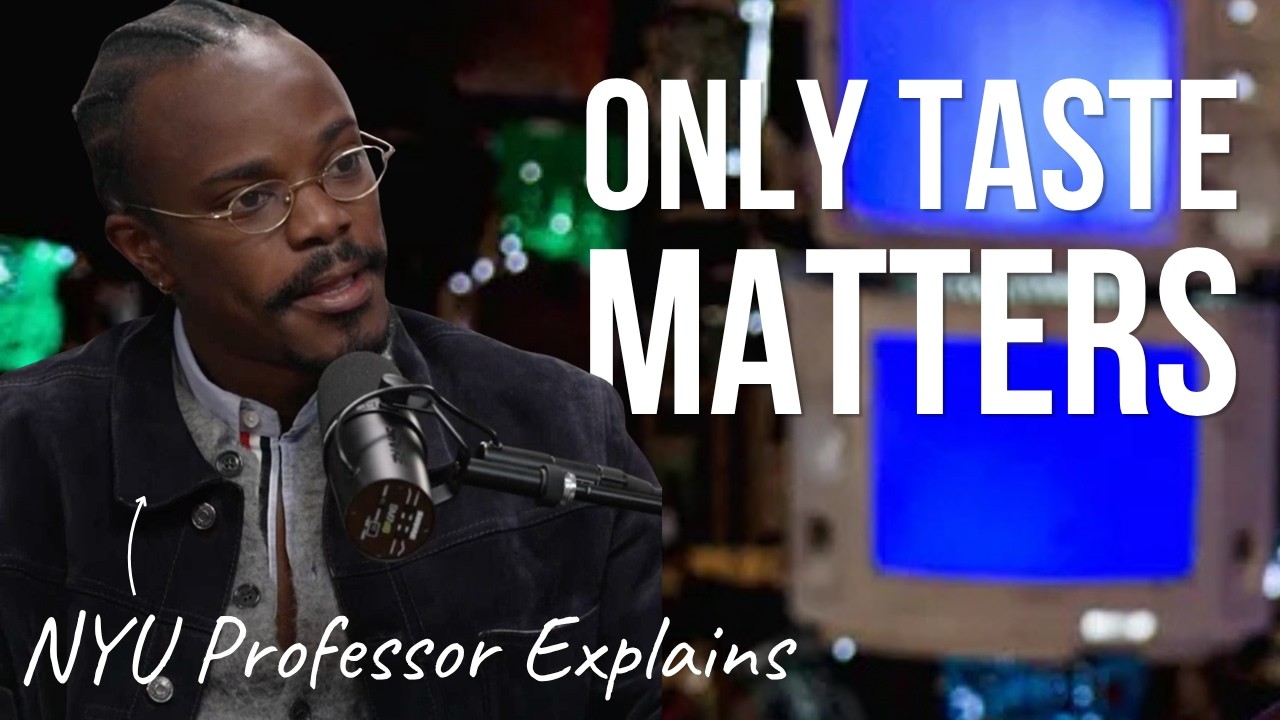
Navigating the AGI Era Virtuously | Ruby Thelot
Ruby Thelot, author of 'A Few Essays on Taste,' argues that taste is not merely aesthetic preference but a way to consume virtuously, emerging during periods of abundance. She draws a parallel between 17th-18th century England—after the 1688 Bill of Rights restrained nobility, creating a nouveau riche with excessive luxury—and today's AI-driven wealth generation, where society again asks how to consume virtuously. Thelot explains that thinkers like the Earl of Shaftesbury and Alexander Pope defined taste as 'harmony with nature,' a virtuous restraint against excess. In the digital age, taste manifests as a means to become 'ungovernable' by algorithms, guiding decisions on which problems to solve. Ultimately, taste is a framework for handling abundance—of intelligence, capabilities, and content—without destroying society.Jul 28, 2026 · 4:24 · 138 views
Taste Is The Only Moat Left | NYU Professor Ruby Thelot Explains
In this episode, NYU professor and cyber ethnographer Ruby Justice Thelot unpacks how internet culture has balkanized into distinct digital communities, each with its own vernacular and norms, and argues that taste—historically a mechanism for virtuous consumption in an age of abundance—is the only moat left in an AI-driven world. Thelot explains that 50% of internet traffic is now bots, introducing 'machinic taste' where algorithms, audiences, and agents shape aesthetics and behavior. He reveals that while Americans broadly distrust 'AI' due to fears of job loss—as shown by his analysis of 5,000 videos on the topic—they enthusiastically use chatbots for practical tasks like fixing a faucet, a sentiment captured in Anthropic's survey of 85,000 users. Thelot also discusses how trends like 'heteropessimism' are often misidentified because journalists' algorithms amplify loud minorities, and he predicts techno-optimism will rise only when AI's benefits directly align with people's desire to remain employed and provide for their families.Jul 28, 2026 · 34:32 · 3.3K viewsSamo Burja discusses the Trump administration's ban on Chinese humanoid robots, arguing it protects national security but harms US power users who rely on Chinese prototyping. He proposes Operation Paperclip Maximizer: granting 50,000 green cards to German and Japanese engineers to reindustrialize US robotics. Burja estimates only about 2,000 live players exist worldwide, with 300 in the US, and notes Silicon Valley generates them by inspiring overspecialized 'dead' players. He contrasts the ban with the need for technology transfer from China, which has surpassed the US in manufacturing high-tech goods like batteries and EVs. Burja also warns that without such transfers, US consumers miss out on innovations like Unitry robots and BYD cars, while China scales robots millions-strong.
Samo Burja joins MTS to discuss the US ban on Chinese robots, the global shortage of live players, and his Operation Paperclip Maximizer proposal to bring German and Japanese engineers to America. -- https://x.com/SamoBurja -- MTS is a live news and interview show covering technology, business, politics, and culture as it happens. Follow MTS: X | https://twitter.com/MTSlive YouTube | https://www.youtube.com/@mtsituation Spotify | https://open.spotify.com/show/4HUNNmV1pjV7CW6Lphm1rM Apple | https://podcasts.apple.com/us/podcast/mts/id1891088763 Substack | https://mtslive.substack.com/ Interested in sponsoring the show? sponsors@mts.now -- Brought to you by: Neon (by Databricks) - Get up to $100K in credits for your startup at https://neon.com/mts ElevenLabs - AI that communicates at human level across every channel and modality. http://elevenlabs.io/mts Kong - The AI connectivity platform. Connect APIs, LLMs, agents, and systems with serious security and governance. https://konghq.com Blitzy - Autonomous software development for enterprise codebases. Ship 5x faster. https://blitzy.com Merge - OpenAI, Dropbox, and Ramp use Merge to get AI to production faster. https://merge.dev/mts AdQuick - Make your brand a billboard. Out-of-home advertising as easy to scale as digital. https://adquick.com Macroscope - AI codebase understanding for engineering leaders. https://macroscope.com/mts -- Timestamps: (00:00) Generating Live Players in Tech (00:03) Trump's Chinese Robotics Ban (00:11) China's Tech Manufacturing Lead (00:15) Policy Debates on AI Models (00:17) Scaling American Robotics Infrastructure (00:19) Counting World's Live Players -- Note: This podcast is not investment, legal, or tax advice, and is intended for informational and entertainment purposes only. Hosts and guests may hold positions in the companies and securities discussed; do your own research before acting on anything you hear.